


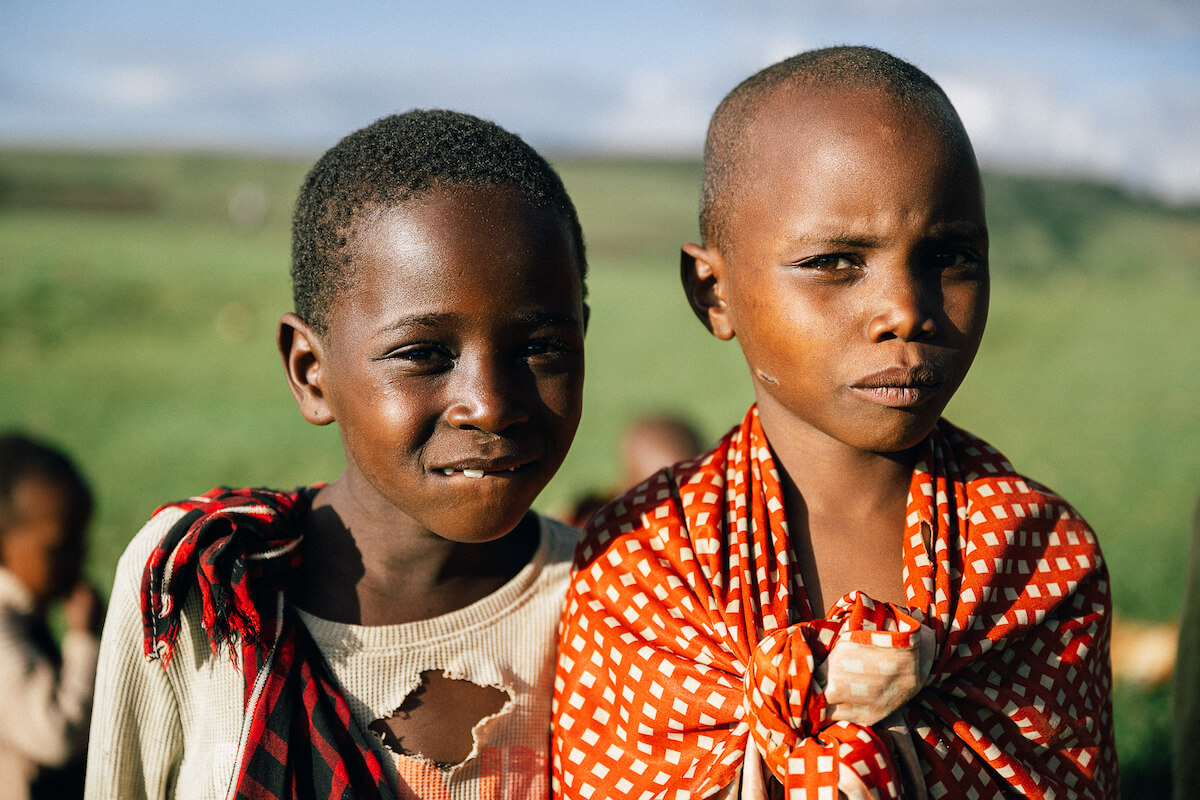


Most children here grow up without it. Boys leave to herd cattle, some as young as five. Girls leave for marriage, sometimes at eleven. MACAO has spent seventeen years working on the reasons with a school, a girls’ programme across the district, and a decade of walking out to the families who live beyond it.
Baraka Eliud and Juliana Nzuna met in Arusha — he had come from Kigoma to work in radio, she had grown up in Sakala village here in Loliondo and trained as an electrical engineer. Juliana brought him back to the rangeland she came from.
They rented a house and began taking in orphaned and vulnerable Maasai children. In 2009 that house became a school: forty children, three teachers, one wooden classroom.
Today it teaches hundreds and boards most of them, and the work has spread outward — to girls in public secondary schools across the district, to families a day’s walk away, to water.
We work on all three, because fixing one without the others doesn’t hold.
Baby class to Class 7, every subject taught in English, most children sleeping on campus. For a girl at risk of marriage, boarding is not a convenience. It is the protection.
Clubs in four public secondary schools, scholarships through secondary, and the slower work — sitting with parents and elders on early marriage and on cutting, year after year.
Ten years of visiting scattered Maasai communities every two weeks — arguing for school, and supporting children into other schools, not only our own.
Government services rarely reach these villages. Families are pastoralists — their wealth is in cattle, and when the rain fails, the cattle die and the school fees stop. Rain has now failed three seasons running.
When we started, most parents preferred their sons to work with livestock and their daughters to marry young. That has shifted. Not because anyone lectured them, but because we kept coming back.
It is also why we do not measure ourselves in children enrolled, but in children still here in Class 7.

“I went home and told my parents I wanted to become a teacher — a teacher with the superpower to educate, to share, to give something to others.”

“When I grow up I am going to be an independent woman. I am planning to build a house for my parents. I know these dreams can be real.”

“Kura is my best friend. But the animals are not enough to send my two sisters and me to school.”
Three hundred to teachers’ salaries, two hundred to food and a bed. About a third of boarding families cannot pay it, and the school carries them.

P.O. Box 84 Loliondo Ngorongoro Arusha Tanzania
info@macao.or.tz
+255 753 044 751
WhatsApp +255 767 816 082
